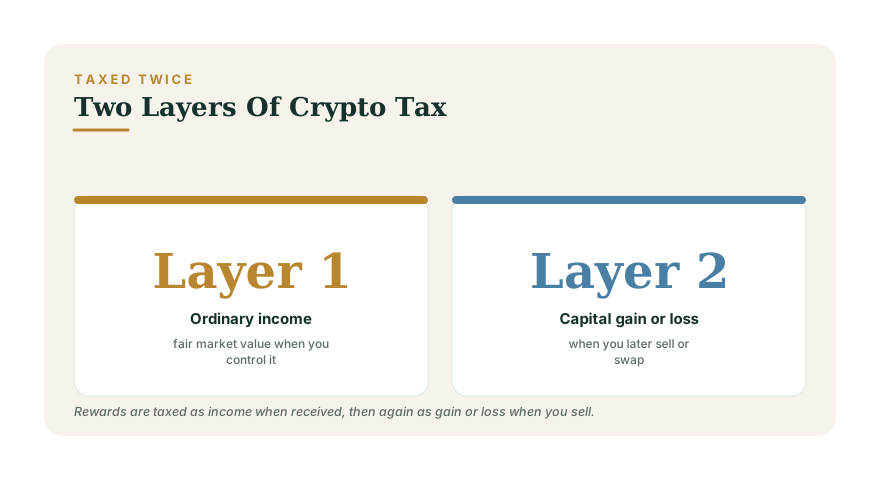
Staking rewards and airdrops feel like bonuses that fall from the sky, so it is tempting to assume they are tax-free until you cash out. That is not how the IRS sees them. In the US, most crypto you receive as a reward is ordinary income the moment you can control it — valued in dollars right then — and then it can be taxed again as a capital gain or loss when you eventually sell. Understanding this two-layer structure prevents an unpleasant surprise at tax time.
Layer one: income when you receive it
When you earn staking rewards — the tokens you get for helping validate a proof-of-stake network — the IRS treats them as ordinary income equal to the fair market value of the tokens at the time you gain dominion and control over them, meaning you can sell, transfer, or otherwise dispose of them. IRS guidance issued in 2023 made this position explicit for staking. So if you receive tokens worth $300 when they hit your control, you have $300 of ordinary income that year, taxed at your regular income rate, whether or not you sell.
How airdrops are taxed
An airdrop — tokens distributed to wallets, often to promote a new project or reward early users — is generally taxed the same way: ordinary income at the fair market value when you receive and can control the tokens. If a token has no established market when it lands and you truly cannot do anything with it, the timing of income can be nuanced, but the safe default is that value received is income received. Hard forks that give you new coins follow similar principles. When in doubt, record the date, the token amount, and its dollar value at receipt.
Layer two: capital gains when you sell
Here is the part people miss. The dollar value you reported as income becomes your cost basis in those tokens. When you later sell or swap them, you have a capital gain or loss equal to the sale price minus that basis. Say those $300 of staking rewards grow to $500 before you sell — you owe capital gains tax on the $200 increase, on top of the income tax you already paid on the original $300. If instead they fall to $200, you have a $100 capital loss. Holding more than a year before selling qualifies the gain for lower long-term rates. The general framework is in Crypto Taxes, Explained, and you can estimate the sale-side tax with our Capital Gains Estimator.
The record-keeping burden is real
This structure means every reward event needs two data points captured at receipt: the token quantity and its dollar value that day. Miss the receipt-date value and you cannot prove your basis later, which can inflate your eventual capital gain. Practical habits:
- Log each staking payout and airdrop with its date, amount, and fair market value.
- Use crypto tax software or a spreadsheet that timestamps values automatically — frequent stakers can accumulate hundreds of tiny events.
- Remember that rewards earned in self-custody or DeFi usually generate no tax form, so your own records are the only record. The new exchange-reporting form is covered in Form 1099-DA, but it does not capture this income cleanly.
Watch out for estimated taxes
Because reward income has no withholding, a year of meaningful staking can leave you owing tax you did not set aside — and possibly an underpayment penalty. If your crypto income is significant, you may need to make quarterly estimated payments, as explained in Quarterly Estimated Taxes, Explained. Setting aside a portion of each reward's dollar value as you go is the simplest defense.
The takeaway
Staking rewards and airdrops are taxed twice by design: as ordinary income when you gain control, then as a capital gain or loss when you sell, with the income value serving as your basis. None of it is optional, and none of it comes with automatic withholding, so the winning move is disciplined record-keeping and setting cash aside for the bill. Run your numbers through the Tax Health assessment, and if crypto income is a growing part of your finances, build it into your wider plan at the planning hub.