Paying for a US college is daunting for any family, but immigrant families face an added layer of complexity: much of the aid system keys off immigration status, and the rules differ depending on whether you are looking at federal aid, state tuition pricing, or private scholarships. Understanding which doors are open to your family — and which are not — lets you plan around the system instead of being surprised by it.
FAFSA eligibility by status
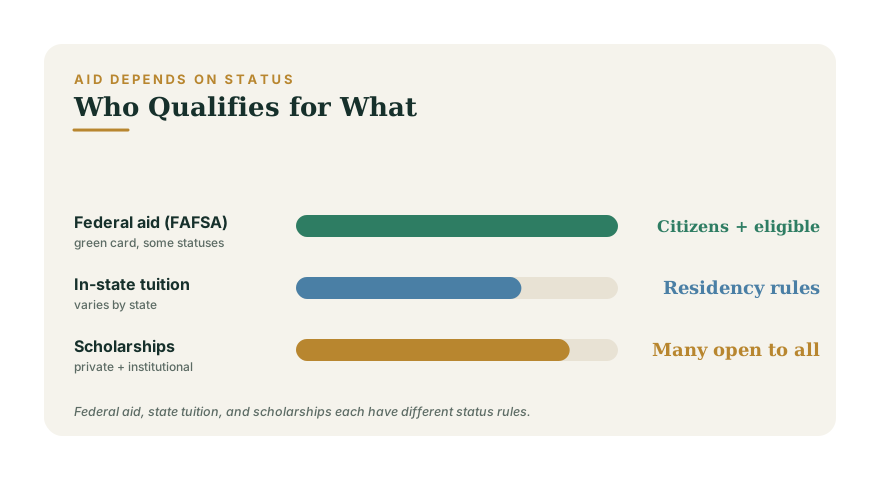
The FAFSA (Free Application for Federal Student Aid) is the gateway to federal grants, work-study, and federal student loans. Eligibility for federal aid generally requires the student to be a US citizen or an eligible noncitizen. Eligible noncitizens include lawful permanent residents (green-card holders) and certain other categories such as some asylees, refugees, and specific visa holders.
Students on typical temporary visas — for example, an F-1 student visa — are usually not eligible for federal aid. Importantly, though, the parents' status does not by itself disqualify a citizen child: a US-citizen student with undocumented or non-citizen parents can still file the FAFSA and qualify for federal aid in their own right. Parents without a Social Security number can complete their portion of the form, and there is a process for that. When in doubt, filing the FAFSA costs nothing and is often worth doing, because some states and colleges also use it to award their own aid.
State residency and in-state tuition
Public universities charge dramatically less for in-state students than for out-of-state or international students — often less than half. In-state pricing is a matter of state residency, which is related to but separate from immigration status. Many states grant in-state tuition to lawful permanent residents and certain visa holders who have established residency, and a number of states extend in-state rates to longtime resident students regardless of immigration status under their own laws.
Because rules vary so much by state, this is worth researching specifically where you live. The savings from qualifying for in-state tuition can dwarf almost any scholarship, so it often deserves the most attention.
529 plans work for everyone
A 529 plan is a tax-advantaged college savings account, and here the news is straightforward: you generally do not need to be a citizen to open or benefit from one. What you need is a Social Security number or ITIN for the account owner and the beneficiary. Money grows tax-free and comes out tax-free when used for qualified education expenses, which makes a 529 one of the cleanest ways for an immigrant family to save for college on US soil. Our full explainer, 529 plans explained, covers contribution mechanics, state tax breaks, and what counts as a qualified expense.
One caution for families who may leave the US: if college ends up happening abroad, check whether the foreign institution is on the list of schools eligible for tax-free 529 withdrawals — many international universities are, but not all. And if you might return home, coordinate with how your home country taxes the account.
Scholarships open to non-citizens
Federal aid is gated by status, but a huge swath of scholarship money is not. Many private scholarships, and a great deal of institutional aid awarded directly by colleges, are open to non-citizens — including international and undocumented students — based on merit, financial need, field of study, or background. Some scholarships are created specifically for immigrant and first-generation students. Colleges themselves are often the largest source of grant aid, and their institutional aid policies for non-citizens vary widely, so a school's own financial-aid office is the place to ask exactly what your student qualifies for.
Students arriving from abroad on study visas have their own distinct money playbook, from banking to budgeting in dollars; our international student money guide covers that ground.
Build the savings habit early
Whatever your status, the most reliable lever is time. Starting a 529 (or even a plain investment account) when a child is young lets compounding do the heavy lifting, so monthly contributions feel small. Setting that up is much easier once your basic US banking is in place — see opening your first US bank accounts as an immigrant if you are still getting established.
Plan the number
College planning rewards families who put a real target on paper early. Estimate the future cost, decide how much of it you want to cover, and back into a monthly savings figure with the College Planner. The College Readiness assessment can then show where your plan is strong and where it needs work.