Many homeowners assume that "disaster" is covered by their insurance, full stop. Then a storm pushes water into the living room, they file a claim, and they discover a hard truth: standard homeowners insurance does not cover flooding. It is not an oversight or a loophole — it is a deliberate, near-universal exclusion. Flood is its own separate policy, and going without it is one of the most expensive gaps a homeowner can leave open.
The standard exclusion
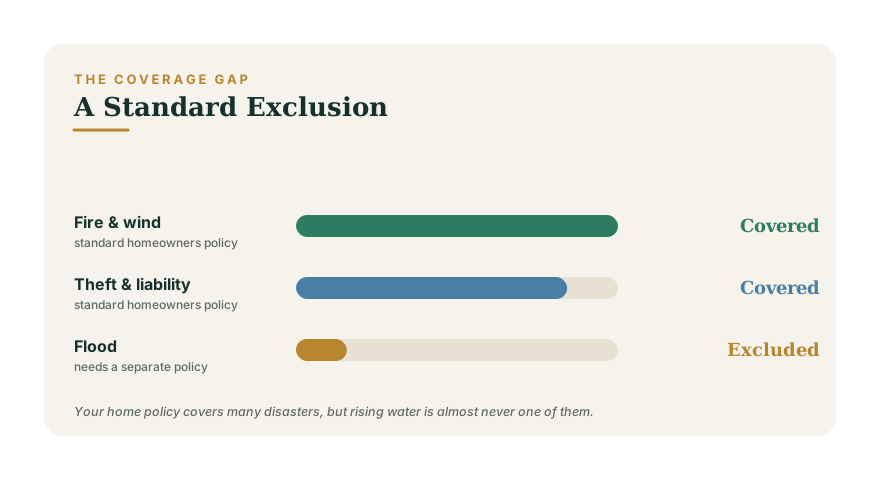
Open almost any homeowners policy and you will find flood listed among the exclusions. The reason is partly historical and partly mathematical: flood losses are catastrophic and geographically concentrated, which makes them hard for a normal insurer to spread risk across. There is an important distinction insurers draw. Water that falls from above and enters through your roof (say, from a windstorm) is usually covered. Water that rises from the ground up — an overflowing river, storm surge, flash flooding, heavy rain that pools and seeps in — is flood, and that is excluded. The same wet basement can be covered or not depending entirely on where the water came from.
The NFIP and private options
Because the private market historically would not touch flood risk, the federal government created the National Flood Insurance Program (NFIP). For decades it was effectively the only way to insure a home against flooding, and it is still the most common source. Policies are sold through regular insurance agents but backed by the federal program. The NFIP covers your building and, separately, your contents, each up to a federal limit.
In recent years a growing private flood insurance market has emerged as an alternative. Private policies can sometimes offer higher coverage limits than the NFIP cap, cover features the NFIP excludes, or come in at a lower price for lower-risk homes. It is worth getting quotes from both. A few things the NFIP typically does not fully cover are worth knowing: a finished basement's contents, temporary living expenses while you are displaced, and the full value of a high-end home above the program's limit.
What flood zones mean
The federal government maps the country into flood zones based on risk. High-risk zones (often labeled with letters like A or V on the maps) are areas with at least a roughly 1-in-4 chance of flooding over the life of a typical mortgage. If your home sits in one of these zones and you have a federally backed mortgage, your lender will require flood insurance — it is not optional. Lower-risk zones are not required to carry it, which is exactly where most people skip coverage.
Why even low-risk areas flood
Here is the statistic that surprises people most: a large share of all flood insurance claims — often cited as more than a quarter — come from properties outside the high-risk zones. Flood maps are based on history, and history is a poor guide to the future. New development paves over land that used to absorb rain, drainage systems get overwhelmed, and a single severe storm can flood a street that has been dry for fifty years. "Low risk" does not mean "no risk." It means the coverage is cheaper, which is often a reason to buy it rather than skip it.
What it costs and how to decide
Premiums vary enormously with your elevation, zone, and the home's value, but flood policies in lower-risk areas can be surprisingly affordable. A few practical notes:
- There is usually a waiting period — often 30 days — before a new NFIP policy takes effect. You cannot buy it as a storm approaches, so do it well in advance.
- One foot of water in a home can cause tens of thousands of dollars in damage. The downside is large even from a "minor" flood.
- Flood coverage has its own deductible, much like the choice you make on your main policy in choosing a home insurance deductible.
The bottom line
Flood is the most common and costly natural disaster in the country, and it is the one your standard policy quietly leaves out. If you own a home anywhere near water, in a flood-prone region, or simply at the bottom of a hill where rain collects, getting a flood quote is a small step that protects you from a six-figure surprise. Treat it as part of the true cost of homeownership, not an optional extra.
Check your home's flood zone on the federal maps, then get quotes from both the NFIP and a private insurer before you decide. As you weigh the premium, fit it into the rest of your housing budget with the home affordability calculator.