Plenty of couples build a life together without getting married — sharing a home, raising children, blending budgets. Financially and legally, though, the law treats unmarried partners as strangers by default. None of the automatic protections that come with marriage apply, which means an unmarried couple has to deliberately build, on paper, the safety net that spouses receive for free. Skip the paperwork and a breakup, an illness, or a death can leave one partner with no legal standing at all.
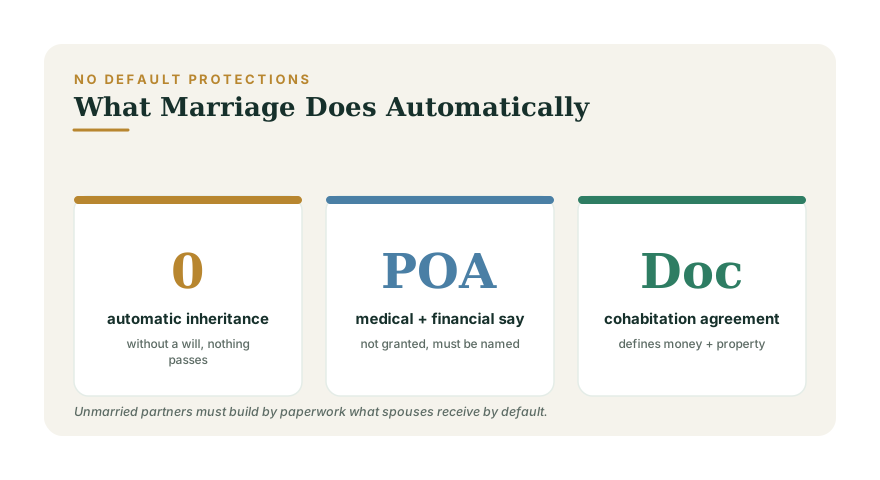
No automatic legal protections
Marriage quietly grants a long list of rights: the ability to inherit without a will, to make medical and financial decisions for an incapacitated partner, to be on each other's health insurance, certain tax treatments, and more. Unmarried partners get none of this automatically. If one partner is hospitalized, the other may have no legal right to make decisions or even receive information. If one dies without a will, the surviving partner may inherit nothing — assets pass to blood relatives instead. This is not a small gap; it is the whole reason the rest of this checklist exists.
A cohabitation agreement: the foundation document
A cohabitation agreement is a written contract between partners that spells out how money and property are handled — who owns what, how shared assets are split if you separate, how household expenses and any jointly bought property (a home, a car) are divided, and what happens to each. Think of it as the practical equivalent of the financial clarity marriage law would otherwise impose. It feels unromantic, but like any clear agreement, it prevents the far uglier disputes that arise when an undocumented arrangement falls apart. Many of the budgeting mechanics translate directly from How to Budget as a Couple; the difference is that you put the ownership rules in writing.
Beneficiary designations and estate documents
Because nothing passes to an unmarried partner automatically, intentional estate documents do all the work:
- Beneficiary designations on retirement accounts, life insurance, and bank accounts pass directly to whomever you name and override your will. Naming your partner here is often the simplest, most powerful step. The mechanics are in Beneficiary Designations Override Your Will.
- A will (or a trust) is essential to leave anything else to your partner, since intestacy laws will not.
- Powers of attorney — financial and medical — give your partner the legal authority to act for you if you cannot. Without them, your partner may be shut out entirely.
For couples with children or significant assets, a trust can add privacy and control. The point is the same throughout: spouses get these protections by default; you get them only by signing the documents.
Titling: how you own things matters enormously
For unmarried couples, how an asset is titled often decides who keeps it. A home owned as joint tenants with right of survivorship passes automatically to the surviving owner; the same home in one partner's name alone does not. A bank account, a car, an investment account — each carries an ownership structure with real consequences. Decide titling deliberately, especially for anything you buy together, and keep records of who contributed what. Getting titling and beneficiaries aligned is the inverse of the merging process described in Combining Finances When You Marry — you are choosing exactly how much to combine, and proving it on paper.
Shared expenses without merging everything
Day to day, many unmarried couples keep finances more separate than married ones, which is reasonable. A common, durable setup is the "yours, mine, and ours" model: each partner keeps individual accounts and contributes to a joint account for shared bills, often in proportion to income. Agree on how rent or mortgage, utilities, and groceries are split, and keep a simple record. The clearer the arrangement while things are good, the less painful any unwinding later. Build the shared-expense plan with the budget analyzer.
Build the safety net you don't get for free
Living together without marrying is a completely valid choice — it simply shifts the work of protection onto you. Put a cohabitation agreement, beneficiary designations, a will, powers of attorney, and deliberate titling in place, and you give each other the security the law otherwise reserves for spouses. Use the estate readiness assessment to find the gaps before life finds them for you.