Single-parent finances run on a thinner margin than almost any other household, because the usual safety nets are gone. There is no second income to fall back on if you lose a job, no partner to take over if you get sick, and no one to split the rising cost of raising children. That does not mean you cannot build security — it means the standard advice has to be adjusted upward, with protection moved to the very front of the line.
One income with dependents changes the math
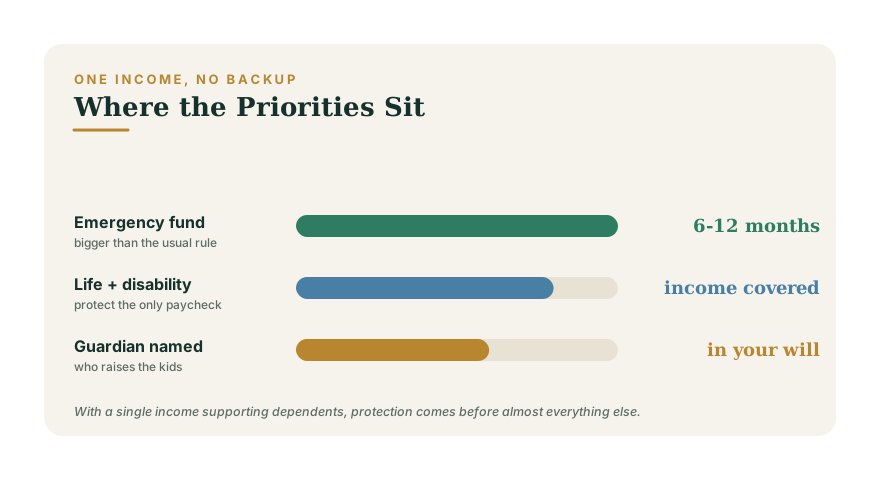
When two adults share a household, a setback for one is cushioned by the other. As a single parent, you are the entire safety net — for yourself and your children. That reality shifts your priorities: before you optimize investments or chase extra return, you build a fortress around the one income that everything depends on. Every recommendation below flows from that single fact.
Build a bigger emergency fund than the textbooks suggest
The common rule of thumb is three to six months of expenses. For a single parent, aim for the higher end — six to twelve months. The reasoning is simple: with no second earner, a job loss or a medical event has no backstop, and a job search while solo-parenting can take longer. A deeper cash cushion is what keeps a hard month from turning into a debt spiral. Start with the framework in the emergency fund guide, then push your target toward the top of the range. Keep it in a high-yield savings account so it stays safe and reachable.
Life and disability insurance are non-negotiable
Two kinds of insurance protect the people who depend on your income:
- Life insurance replaces your income if you die, so your children are provided for. Affordable term life — enough to cover years of living expenses, childcare, and future costs like college — is the right tool for almost every single parent. Permanent policies are usually an expensive distraction.
- Disability insurance is the one people skip, yet you are statistically far more likely to be unable to work for a stretch than to die young. It replaces part of your paycheck if illness or injury keeps you off the job. The case for it is laid out in the most ignored insurance.
If your employer offers either through work, that is often the cheapest starting point — but check whether the coverage amount is actually enough for a household that leans entirely on you.
Name a guardian — and put it in writing
This is the planning step single parents most often delay, and it is the most important. If something happens to you, who raises your children, and who manages the money you leave for them? Without a will that names a guardian, a court decides — possibly not as you would have. Naming a guardian, and ideally a separate person or trust to manage the money, is the core of protecting minor children. Walk through it in Guardianship for Minor Children and the broader estate planning for young families. Pair the will with up-to-date beneficiary designations on your retirement and life-insurance accounts, since those override your will.
Use child support and benefits — but don't bank your survival on them
Child support, when it exists, is real income and belongs in your budget. But treat it as a supplement rather than a foundation, because payments can be inconsistent. Build your essential budget around your own reliable income, and let support accelerate goals rather than cover the rent. Beyond support, look into benefits and credits aimed at working families and dependents — tax credits for children and childcare, dependent-care accounts at work, and education benefits — which can meaningfully lower your real cost of raising kids.
Then build, deliberately and automatically
Once the fortress is up — fund, insurance, guardian — you can move to growth: capture any retirement match, chip away at high-interest debt, and start a small college fund only after your own foundation is solid. Automate every piece so it happens without willpower. A clear monthly plan keeps a single income stretching further; build yours with the budget analyzer, and check where you stand overall with the Financial Wellness Score.