The Employee Stock Purchase Plan, or ESPP, is one of the most overlooked benefits on a corporate menu — and for the most generous plans, one of the most valuable. In plain terms, an ESPP lets you buy your company's stock at a discount using money set aside from your paycheck. When the plan is structured well, it is about as close to free money as an employee benefit gets.
How an ESPP works
You enroll and choose a percentage of your paycheck — within a plan limit — to set aside. Over an offering period, often six months, those after-tax dollars accumulate. At the end of the period, the plan uses that accumulated cash to buy company shares at a discount, and the shares appear in your brokerage account. You did not pay anything extra; you simply redirected money you would otherwise have taken home, and bought stock below market with it.
The discount and the lookback
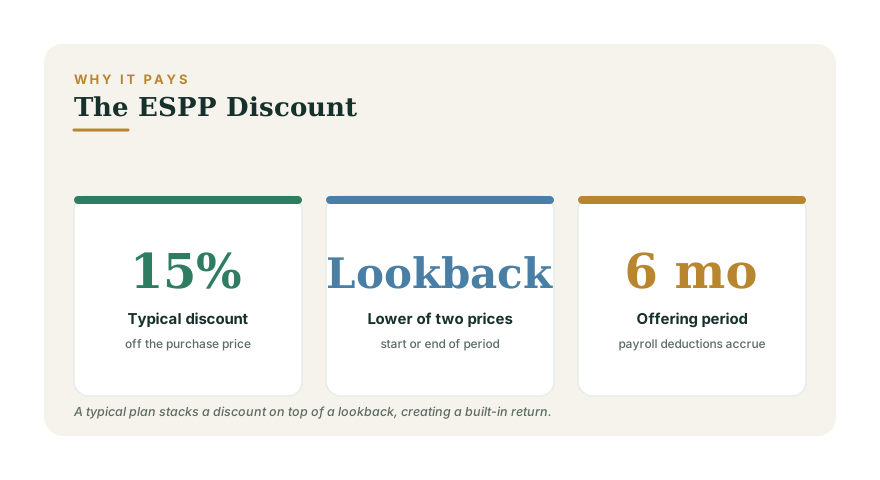
Two features drive the value. The first is the discount — commonly up to 15% off the purchase price. A 15% discount means you pay 85 cents for a dollar of stock the instant you buy it.
The second, and the part that makes the best plans shine, is the lookback. With a lookback, the discount applies to the lower of the stock price at the start of the offering period or the price at the end. If the stock rose during the period, you still buy at a discount off the lower starting price — stacking a price gain on top of the discount. If the stock fell, you buy at a discount off the lower ending price. Either way the lookback works in your favor, and in a rising market it can push your effective discount well above the headline number.
Qualifying vs disqualifying dispositions
The tax treatment depends on how long you hold the shares before selling, and the IRS uses two unfriendly terms for it.
- A disqualifying disposition happens when you sell before meeting the holding rules (generally within two years of the offering start and one year of purchase). The discount portion is taxed as ordinary income, and any additional gain is a capital gain. This is what happens if you sell right away.
- A qualifying disposition happens when you hold long enough — at least two years from the offering date and one year from purchase. More of your gain can then be taxed at lower long-term capital gains rates, though part of the discount is still ordinary income.
Selling immediately means a disqualifying disposition and more ordinary-income tax — but you still keep most of the discount as profit. Holding for the qualifying window can save tax, but it forces you to keep concentrated company stock and bet on the price. As with RSUs, tax efficiency should not override good diversification. Whichever path you pick, track your cost basis carefully, because ESPP basis reporting is a notorious source of double-counting errors at tax time.
Why the discount is near-free money
Strip away the jargon and the math is striking. With a 15% discount and no lookback, buying at 85 cents on the dollar and selling immediately locks in roughly a 17.6% return on the cash you put in (a dollar of value for about 85 cents). Annualize that over a six-month offering period and the return on a low-risk, repeatable move is hard to match anywhere else. Even after the ordinary-income tax on a quick sale, you keep most of that built-in gain.
That is why a common strategy is to max the ESPP and sell shortly after each purchase, capturing the discount while minimizing the time your money is exposed to a single stock. The discount is the return; the stock-price bet is optional risk you do not have to take. You can model the payoff with our RSU and ESPP calculator.
The one caution
The usual concentration warning applies: holding a growing pile of one employer's stock — on top of drawing your salary from that same employer — concentrates your financial life dangerously. The cleanest way to enjoy an ESPP is to harvest the discount regularly and diversify the proceeds. If you are still mapping out which benefits to prioritize, start with your job's benefits package, then run the whole picture through the planning hub.