Childcare is one of the largest line items in many family budgets, and the tax code offers a measure of relief. The Child and Dependent Care Credit gives working parents and caregivers back a portion of what they spend on care that lets them hold a job. It is narrowly defined, frequently confused with the Child Tax Credit, and easy to mishandle if you also have a dependent-care flexible spending account — so it pays to understand how it actually works.
What the credit is for
This credit exists for a specific reason: to offset the cost of care you pay so that you (and your spouse, if married) can work or look for work. That work requirement is the heart of it. If you are paying for care while you are employed, job-hunting, or a full-time student, the cost may qualify. Care paid simply for convenience while you are not working generally does not.
It is a separate, distinct break from the Child Tax Credit. The Child Tax Credit rewards you for having a qualifying child at all; this credit rewards you for paying someone to care for that child while you earn a living. Many families claim both in the same year.
Who and what qualifies
The care has to be for a qualifying person, which typically means a child under age 13, or a spouse or dependent of any age who cannot care for themselves and lives with you. The person must generally be your dependent under the rules in The Rules for Claiming Dependents.
Eligible expenses are broader than just a daycare center:
- Daycare, nursery school, and preschool (but not kindergarten or higher tuition, which is education rather than care).
- Before- and after-school programs for younger children.
- Day camps during school breaks — though overnight camps do not count.
- A nanny, babysitter, or in-home caregiver, including their share of related employment taxes.
You will need the care provider's name, address, and taxpayer identification number to claim the credit, so collect that information during the year rather than at filing time.
How the credit is calculated
The credit is a percentage of your eligible care expenses, up to a dollar cap that is higher if you are paying for the care of two or more qualifying people. The percentage is larger for lower-income families and steps down as income rises, but unlike some credits it does not disappear entirely for higher earners — it just settles at a smaller percentage. There is also an earned income limit: your eligible expenses cannot exceed your earned income, and for married couples, the lower-earning spouse's income effectively caps the benefit. The credit is nonrefundable, so it can reduce your tax to zero but not below.
How it interacts with a dependent-care FSA
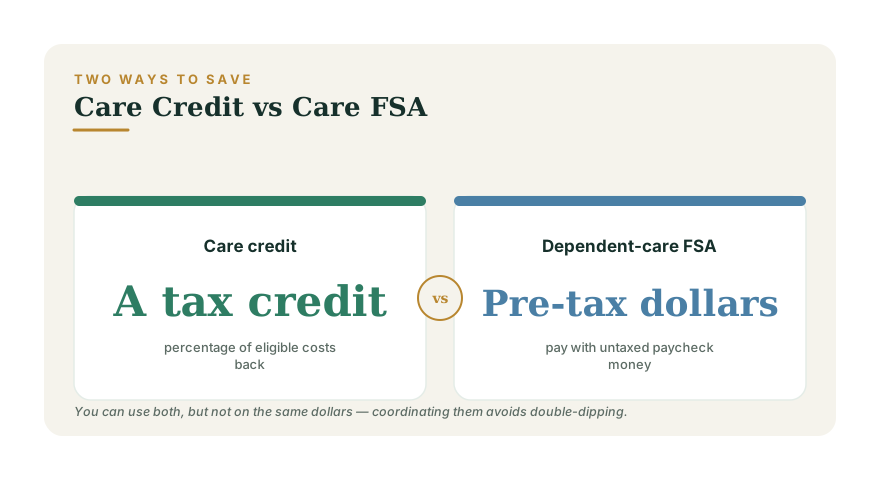
This is where families most often go wrong. A dependent-care flexible spending account lets you set aside pre-tax money from your paycheck to pay for the same kinds of care. Because that money is never taxed, an FSA is often the more valuable option for higher earners, while the credit can be better for lower earners — the trade-off is similar in spirit to the account comparisons in FSA vs HSA: Which One.
The crucial rule is that you cannot use both tax breaks on the same dollars. Any care expenses you pay through a dependent-care FSA reduce the amount you can run through the credit. In practice, money routed through the FSA comes out of the pool of expenses eligible for the credit, dollar for dollar. Some families with high care costs and two or more children can use the FSA up to its limit and still apply the credit to a remaining slice of expenses — but you have to coordinate the two carefully to avoid double-counting, which tax software will flag.
Common mistakes to avoid
- Claiming overnight camp or school tuition. Only day care and day camps qualify; sleepaway camp and kindergarten-and-up tuition do not.
- Forgetting the provider's tax ID. Missing this can hold up or disqualify your claim.
- Double-dipping with an FSA. Running the same expense through both the FSA and the credit is not allowed.
- Assuming a non-working spouse's expenses count. Both spouses generally need earned income (or to be students or job-seeking).
Plan your care strategy ahead of time
Because the FSA election is locked in during open enrollment and the credit is calculated at filing, the smart move is to decide your approach before the year begins rather than after. Run the numbers through the tax strategies tool to compare the FSA and the credit for your income, and use the Tax Health assessment to confirm you are capturing every family tax break available to you.