If you are carrying a balance on a high-interest credit card, a balance transfer card can be one of the most useful tools available. Done with discipline, it can wipe out months of interest and get you to debt-free faster. Done carelessly, it resets the clock, adds a fee, and leaves you exactly where you started — or worse. The tool is fine; the outcome depends entirely on the plan you bring to it.
What a balance transfer actually is
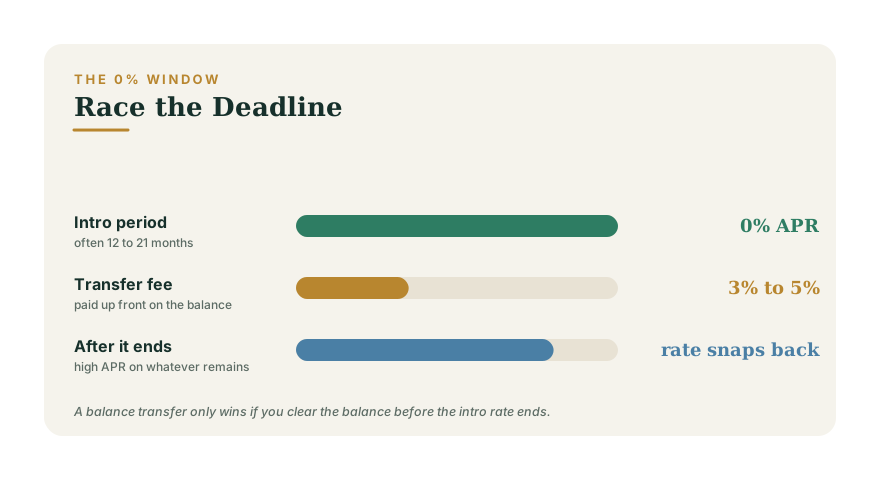
A balance transfer moves debt from one credit card (charging a high APR) to a new card offering 0% interest for an introductory period, often somewhere between 12 and 21 months. For that window, your entire payment goes toward the principal instead of being eaten by interest. On a few thousand dollars of card debt, that can mean hundreds of dollars of interest avoided — but only if you use the window well.
The transfer fee
The catch most people overlook is the balance transfer fee, typically 3% to 5% of the amount moved, charged up front. Transfer $5,000 at a 4% fee and you immediately add $200 to the balance. For most high-interest debt, that fee is still far cheaper than the interest you would otherwise pay, so the transfer is worth it — but you have to do the math, not assume. Compare the fee against the interest you would pay if you simply stayed put.
The deadline trap
The biggest danger is the 0% deadline. When the intro period ends, the rate snaps back to a normal — often high — APR on whatever balance remains. People treat the 0% as breathing room, relax, and arrive at the deadline still owing most of the balance, now facing a steep rate again. The transfer bought time, but if you do not use that time to pay down the debt, you have just paid a fee to delay the problem.
Read the offer terms carefully, too. Watch for a deferred-interest structure (more common on store financing), where missing the payoff deadline can retroactively charge interest back to day one. A true balance transfer card usually charges interest only going forward, but always confirm. The fine print on these offers is dissected in How to Use a Credit Card Responsibly.
The disciplined payoff plan
A balance transfer is only worth doing if you commit to a specific payoff plan before you transfer. Here is the disciplined version:
- Divide and conquer. Take the full balance (including the transfer fee) and divide it by the number of 0% months. That is your required monthly payment to hit zero exactly when the intro period ends. Transfer $5,200 with 16 months of 0%? Pay about $325 every month, no exceptions.
- Automate it. Set up autopay for that fixed amount so it cannot slip. Aim to finish a month early as a buffer against a late or missed payment that could void the offer.
- Stop using the old card. The transfer frees up the old card's limit; do not refill it. Lock it away. Adding new debt while paying off old debt is how people end up with two balances instead of one.
- Make no new purchases on the transfer card. New purchases may not get the 0% rate and can complicate how payments are applied. Use the card for the transferred balance only.
To build that monthly number into a real schedule, run it through the Debt Payoff Calculator and treat the result as a fixed bill.
When a balance transfer is the wrong move
It is not for everyone. Skip it if you cannot realistically clear most of the balance within the intro window — you would just pay a fee to postpone. Skip it if the underlying problem is overspending rather than a one-time balance, because a fresh 0% card with a new limit can tempt more spending; this is the core risk in The Hidden Traps in Debt Consolidation. And you generally need decent credit to qualify for the best offers in the first place.
The honest summary
A balance transfer is a tool for the disciplined, not a rescue for the overwhelmed. If you have a defined balance, a steady plan to pay it off within the window, and the discipline not to add new debt, it can save real money and accelerate your payoff. If any of those is missing, the fee and the deadline tend to win. Either way, pair it with a broader payoff strategy — How to Pay Off Credit Card Debt walks through the full plan — so the card debt does not come back once it is gone.