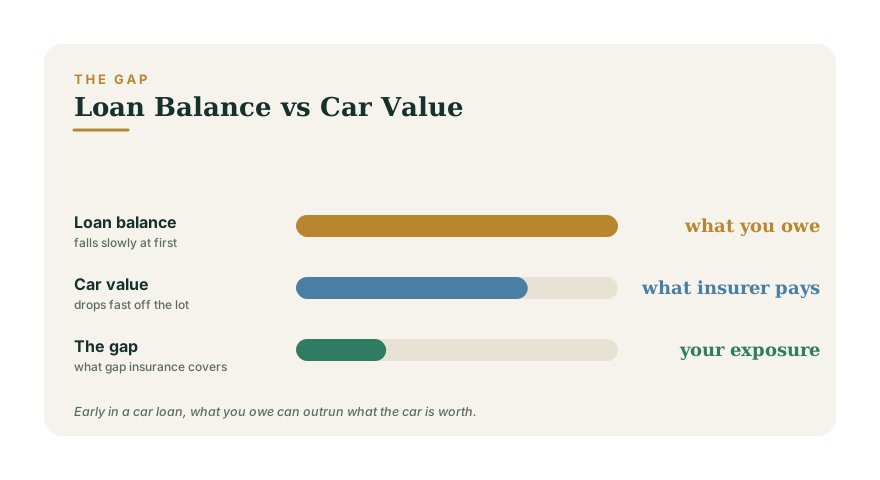
A new car loses a large slice of its value the moment you drive it home, and it keeps dropping fast for the first couple of years. Your auto loan, meanwhile, barely moves at the start because early payments are mostly interest. For a stretch of months — sometimes more than a year — you can owe the lender more than the car is actually worth. That difference is called being "upside down," and it is the exact problem gap insurance exists to solve.
Most drivers never think about it until the car is totaled or stolen. At that point a standard insurance payout is based on the car's market value, not your loan balance — and the difference can be thousands of dollars you still owe on a vehicle you no longer have.
Why a new car can be worth less than you owe
Depreciation and loan math work against you at the same time. A typical new car can lose roughly a fifth of its value in the first year and continue falling steeply for a few years after. A long loan term — six or seven years is now common — stretches your principal payments thin, so the balance falls slowly. Put a small down payment on a long loan and you can spend the first year or two underwater.
This is also a reason long car loans deserve a second look in the first place: they make the upside-down window wider and last longer.
What gap insurance actually covers
"GAP" stands for Guaranteed Asset Protection. If your car is totaled or stolen, gap coverage pays the difference between your insurer's value-based payout and the remaining balance on your loan or lease. Without it, you keep paying off a loan on a car that no longer exists.
A few things gap insurance does not do, which people often assume it does:
- It does not cover repairs, mechanical breakdowns, or routine damage — that is your regular auto coverage.
- It only pays out alongside a total-loss or theft claim, so you must also carry comprehensive and collision coverage for it to function.
- It usually does not cover your deductible, missed payments, or negative equity rolled in from a previous car loan (read the fine print here).
When you actually need it
Gap insurance is genuinely useful in a narrow set of situations. Consider it when most of these are true:
- You made a small down payment (under roughly 20%).
- You took a long loan term, so the balance falls slowly.
- You are leasing — many leases require gap coverage, and it is often built in.
- You rolled negative equity from an old loan into the new one.
- You bought a model that depreciates quickly.
In all of these, the gap between value and balance is wide and an unlucky accident could leave you owing thousands on nothing.
When to skip it or drop it
If you paid cash, made a large down payment, or financed a modest amount on a short term, you may never be underwater at all — and gap coverage would be paying for a risk that does not exist. The same logic applies as the loan ages: the moment your balance drops below the car's value, the gap closes and the coverage stops doing anything.
Because of that, gap insurance is meant to be temporary. Set a reminder to compare your loan balance against the car's estimated value once or twice a year. As soon as you have positive equity, cancel it. If you bought a multi-year gap policy up front and cancel early, you are often owed a prorated refund — ask for it.
Where to buy it (and where not to)
Dealers love to sell gap coverage at signing, often at a marked-up flat fee folded into the loan, where it quietly accrues interest. Your own auto insurer usually offers the same protection as a small monthly add-on that you can drop the day you no longer need it. Compare both before agreeing to the dealer's version, and never let it be bundled in without a clear price.
The bigger principle
Gap insurance is a clean example of a good insurance rule: insure the loss you genuinely could not absorb, for exactly as long as that loss is possible, and not a day longer. Owing five figures on a destroyed car is a real, hard-to-absorb shock early in a loan; paying for that protection once you have equity is just waste. The same discipline applies across your whole policy lineup — see when skipping coverage is actually the smart move.
To see whether your auto and other coverages are sized to your real exposures rather than a salesperson's pitch, run the numbers through the Insurance Needs Calculator and pressure-test the rest of your safety net with the Financial Resilience Assessment.