A 200 dollar signup bonus is the most effective hook in consumer finance. It is concrete, it feels like found money, and it triggers the part of your brain that loves a guaranteed win. The catch is rarely in the bonus itself. It is in the words right next to it: spend 3,000 dollars in the first three months.
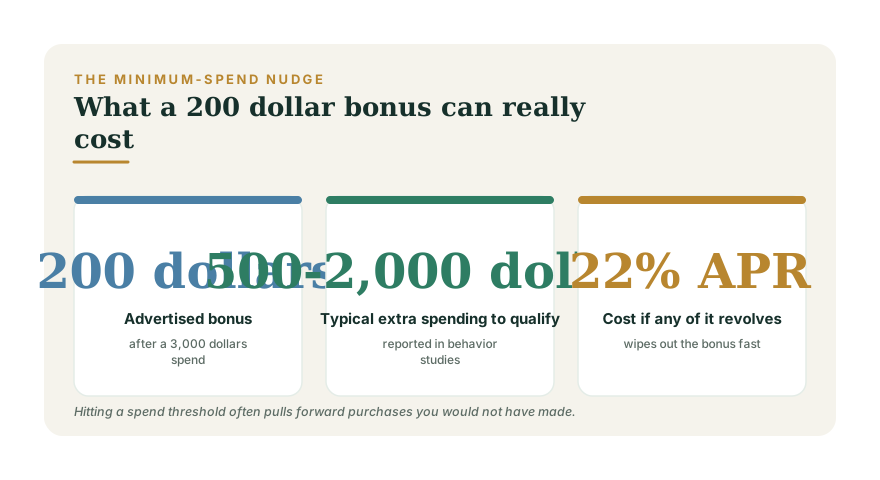
The honest truth is that the bonus is not the product. The spending requirement is the product. The bank is paying you 200 dollars to change your behavior, and for many people the behavior it changes costs more than 200 dollars.
Follow the Money
Banks do not give away bonuses out of generosity. A welcome offer is a customer-acquisition cost, and they model it carefully. They know that a minimum-spend threshold does three profitable things at once.
First, it filters for spenders. Someone who can swipe 3,000 dollars in 90 days is a high-value customer worth far more in future interchange and interest than the bonus costs. Second, it accelerates spending. A deadline creates urgency, and urgency loosens wallets. Third, and most lucrative, a fraction of bonus-chasers will overspend, miss a payment, or carry a balance to hit the target. Once interest starts, the bank recovers the bonus many times over.
The Behavioral Math
The danger is not the bonus arithmetic. On paper, 200 dollars for spending money you were going to spend anyway is excellent, an instant return measured in the thousands of percent. The danger is the gap between planned spending and what the threshold pulls out of you.
Say your normal three-month spend is 1,500 dollars but the bonus requires 3,000 dollars. To qualify you need to find an extra 1,500 dollars of spending in a short window. Behavioral research on minimum-spend offers consistently finds that people pull purchases forward, buy things they would have skipped, or upgrade to pricier options to clear the bar. If even half of that extra 1,500 dollars is spending you would not otherwise have done, you spent 750 dollars to earn 200 dollars. That is not a bonus. That is a 550 dollar loss dressed as a win.
Now add the worst case. If the spending spree leaves you unable to pay the full statement and you revolve even 1,000 dollars at 22% for a few months, the interest alone can eat the entire bonus. The math flips from clever to costly without you ever feeling reckless.
When Chasing a Bonus Is Genuinely Fine
None of this means bonuses are a scam. For a specific, disciplined person they are real money. The bonus works when every one of these is true.
- The minimum spend is below what you would spend anyway in that period, so you are not inventing purchases.
- You pay the statement in full every month, so no interest touches the spending.
- You have a plan for the natural spend, large bills, planned purchases, normal expenses, rather than a scramble at the deadline.
- The annual fee, if any, is less than the bonus value plus the rewards you will actually use.
If you meet those conditions, a welcome bonus is one of the highest-return moves in personal finance, precisely because you are extracting the marketing budget without falling for the behavioral trap it was built around.
How to Protect Yourself
- Before applying, write down your real planned spending for the next three months. If it already clears the threshold, the bonus is safe to chase. If it does not, walk away.
- Never buy something solely to hit a spend requirement. The moment you do, the bank has won.
- Do not prepay bills, buy gift cards, or front money you do not have just to qualify. That is borrowing against yourself to earn a smaller amount.
- Set full-balance autopay the day the card arrives, so an interest charge can never erase the bonus.
- Track the deadline, but let it pass unmet if hitting it means overspending. A missed bonus costs nothing. A chased one can cost plenty.
The Decision Rule
- Would your normal spending hit the minimum without any change in behavior? If no, skip it.
- Will you pay every statement in full? If no, skip it.
- Is the bonus larger than any annual fee in year one? If no, the offer is weaker than it looks.
- Are you tempted to buy anything extra to qualify? If yes, that temptation is the trap working.
Our Honest Recommendation
Only chase a signup bonus on spending you would do regardless. Treat the bonus as a rebate on inevitable purchases, never as a reason to find new ones. If you are organized enough to pay in full and your ordinary spending clears the bar, take the money, it was carved out of the bank's marketing budget for exactly this. If hitting the threshold would require even one purchase you would not otherwise make, the honest move is to pass.
Before you apply for the next shiny offer, map your real upcoming spending and your payoff discipline. The calculators under tools and the timeline view at your plan make it easy to see whether the bonus is a gift or a nudge. Browse more straight-talk pieces at our articles before you sign up.