The credit card industry sells travel rewards as the savvy choice and cash back as the boring one. The marketing works: people imagine business-class flights and free hotels. The reality for most cardholders is duller and more expensive. They earn points worth a cent or less, let them sit, and watch the issuer quietly devalue them. Meanwhile a plain 2% cash-back card would have paid more with zero effort.
This is not an argument that travel points are worthless. It is an argument that you should know your real cents-per-point before you assume the fancy card is winning.
The Honest Truth: One of These Numbers Is Fixed
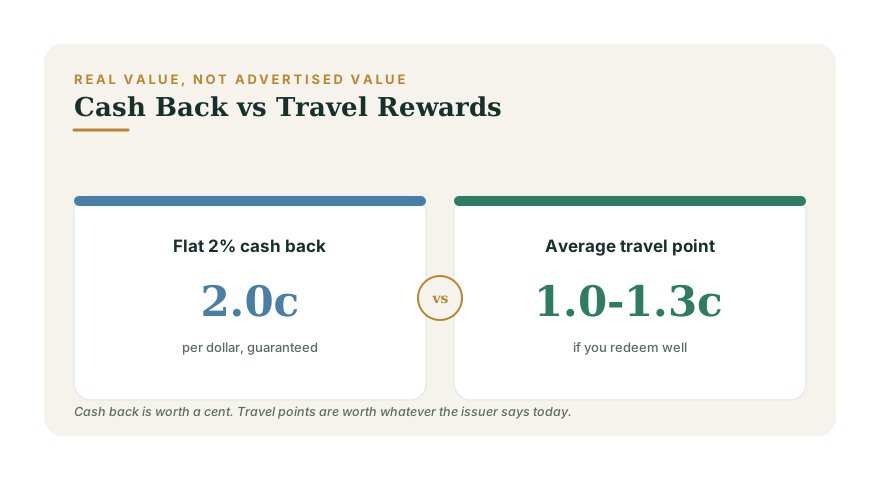
Cash back is transparent. One point equals one cent. A 2% card on $30,000 of spending gives you $600. There is no chart to study, no transfer partner to learn, no expiration to track. The value cannot be revised after you earn it.
Travel points are different. Their value is set by the issuer, published in award charts, and changed whenever the issuer wants. The "1.5 cents per point" you saw advertised is a best case, not a promise. The day after you earn them, the airline can raise the price of an award seat and your points are worth less. You did nothing wrong and your balance just shrank.
Follow the Money
Points are a liability on the issuer's balance sheet, and a liability they control. "Dynamic pricing" on award flights, periodic devaluations, and seats that never seem available at the saver rate all push the average redemption value down. Industry data and frequent-flyer analysts routinely peg the typical point redemption at roughly 1 to 1.3 cents. The eye-popping 5-cent business-class redemptions exist, but they require flexibility, planning, and a tolerance for hunting award space that most people do not have.
The breakage is the business model. Points that expire, go unredeemed, or get cashed out at a poor rate are pure margin for the issuer. They are counting on the gap between the value they advertise and the value you actually capture.
The Math
Take a household spending $30,000 a year on cards.
- Flat 2% cash back: 2 cents per dollar, no thinking required. Value: $600.
- Travel card at average redemption: say you earn 1.5 points per dollar and redeem at 1.1 cents each. That is 45,000 points worth about $495, minus whatever the annual fee costs you.
- Travel card, optimized: same 45,000 points redeemed at 2 cents each through a transfer partner you researched. Value: $900, if and only if you do the work consistently.
The optimized case wins clearly. The average case loses to plain cash back, especially once a $95 to $250 annual fee is subtracted. The question is not which card can pay more. It is which one you will actually extract value from.
When Travel Points Genuinely Win
Points beat cash back when all of these are true: you redeem regularly rather than hoarding, you target high-value redemptions of 2 cents or more, you are flexible on dates and routes, and the card's bonus categories match your real spending. A disciplined traveler who consistently pulls 2-plus cents per point is leaving money on the table with cash back. That person knows who they are. Most cardholders are not that person and quietly assume they are.
How to Protect Yourself
- Compute your real cents-per-point. Take the dollar value of a redemption you actually made and divide by the points it cost. If it is under 1.5 cents, you are likely better off in cash.
- Subtract the annual fee first. A $250 fee means the card must beat your no-fee 2% option by $250 in real, captured value before it is even.
- Do not hoard. Points lose value over time. Cash does not.
- Be honest about your habits. If you have not booked an award trip in two years, your points strategy is a cash-back strategy in a more expensive costume.
Your Decision Rule
- If you will not consistently redeem at 2 cents per point or more, choose flat 2% cash back.
- If you redeem travel often, flexibly, and at high value, a travel card can win, after fees.
- Always net out the annual fee before comparing.
- When in doubt, take the cash. Guaranteed value beats advertised value.
The Honest Recommendation
For most people, a no-annual-fee 2% flat cash-back card is the highest reliable return they will get, and it costs zero ongoing effort. Treat travel points as a hobby that can pay well if you genuinely work at it, not as the default smart move. The issuer is betting you will earn like an optimizer and redeem like everyone else.
Run your own numbers honestly: pull a recent redemption, divide value by points, and see what you really earned. Compare card strategies in our tools, and if you want to learn the full reward-math framework, start with our articles on credit card rewards.