Premium cards are sold as a club. Pay the annual fee and you unlock lounges, travel credits, status, and a heavier piece of metal. The marketing is built to make 550 dollars feel like a bargain. For a small slice of cardholders it genuinely is. For most, the fee quietly outruns the value, and the perks that justified it sit unused.
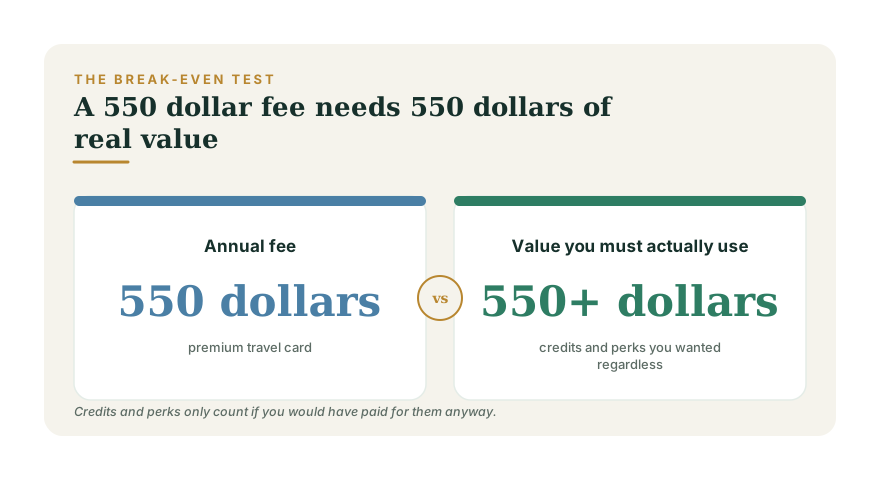
The honest truth is that an annual fee is only worth it if you would have spent that money on the perks regardless. Otherwise you are not buying value. You are buying the feeling of value.
Follow the Money
Annual fees exist because they are pure, predictable profit. Unlike interest, which depends on customer behavior, the fee is charged every year no matter what. Card issuers load fee cards with credits and benefits that look large on paper but rely on a well-documented pattern: most people do not fully use them.
That gap is the business model. A card might advertise 300 dollars in travel credit, 100 dollars in dining credit, and 120 dollars in streaming credit. The bank knows that the average holder will claim only part of that, especially credits that are split into awkward monthly chunks or require specific merchants. The unredeemed value is the issuer's margin. The fee is set assuming you will leave money on the table.
The Break-Even Math, Honestly Done
The only fair way to judge a fee card is to count value you would have paid for anyway. A travel credit only counts if you were going to spend on travel regardless. A dining credit only counts at restaurants you would have visited and paid full price for. Anything you use just because it is there is not value, it is induced spending.
Take a 550 dollar card with a 300 dollar travel credit, lounge access, and a points-earning rate on travel. If you fly enough to use the full 300 dollar credit and you would visit lounges anyway, you are already at 300 dollars. If your travel spending earns, say, another 150 dollars in points value over a no-fee card, you are at 450 dollars. You still need 100 dollars more in benefits you genuinely use to break even. Many people never get there.
Value points conservatively. The marketing loves to quote inflated redemption rates, but a safe, honest baseline is about 1 cent per point. At 1 cent, 30,000 points is 300 dollars, not the 600 dollars some transfer charts imply. If a card only pencils out using optimistic point valuations and perfect redemptions you will never actually execute, it does not pencil out.
When a Fee Card Genuinely Wins
Fee cards are not a trap for everyone. For the right profile they are clearly the better choice.
- You travel heavily and would pay for lounges, checked bags, or travel credits out of pocket anyway.
- The recurring credits map onto spending you already do at full price, not spending you have to invent.
- Your spending volume in bonus categories earns enough extra rewards to cover a chunk of the fee on its own.
- You pay in full every month, so no interest is quietly eating the rewards the fee was supposed to buy.
If those are true, the metal card earns its keep. If even one is shaky, a strong no-fee card usually delivers more real money to your pocket.
How to Protect Yourself
- Do the worksheet before you apply and again before each renewal. List every credit and perk, then write next to each one the amount you would have spent anyway. Total only that column.
- Value points at 1 cent unless you have a concrete, repeatable redemption that beats it.
- Ignore status and the weight of the card. They are not value, they are atmosphere.
- When the renewal hits, call and ask whether the math still works. If a perk lapsed or your travel dropped, downgrade to a no-fee card or cancel.
- Never carry a balance on a fee card. Paying 22% interest to access a 300 dollar credit is a spectacular loss.
The Decision Rule
- Add up only the credits and perks you would pay for regardless. Does that total plus realistic extra rewards exceed the fee? If no, do not get the card.
- Are you valuing points at 1 cent? If you need a higher number to break even, the card fails.
- Will you actually claim the recurring credits, including the fiddly monthly ones? If you are honest and the answer is no, subtract them.
- Do you pay in full every month? If no, no fee card is worth it yet.
Our Honest Recommendation
For most people, a no-fee 2% cash back card beats a premium fee card once you count only the value you truly use. Fee cards win for heavy travelers whose credits and perks line up with spending they would do anyway, and who pay in full. Everyone else is better off keeping the fee and the rewards in their own pocket.
Before you pay or renew an annual fee, run the break-even worksheet line by line, counting only what you would have bought regardless and valuing points at a cent. The calculators under tools make the arithmetic quick, and you can fold the result into the bigger picture at your plan. A fee is worth paying only when the value is real to you, not just real in the brochure.