Your advisor remembers your dog's name and asks about your daughter's college search. It feels personal, and that feeling is exactly what you are paying for. But step back and run the arithmetic on how many clients one human can truly know, and the warm relationship starts to look less like a friendship and more like a well-rehearsed product.
The honest take: a typical advisor manages so many clients that deep, individualized attention for each one is mathematically impossible. The relationship is not a lie exactly. It is a service designed to feel personal at scale, and the difference matters when it is your retirement on the line.
The Math of Attention
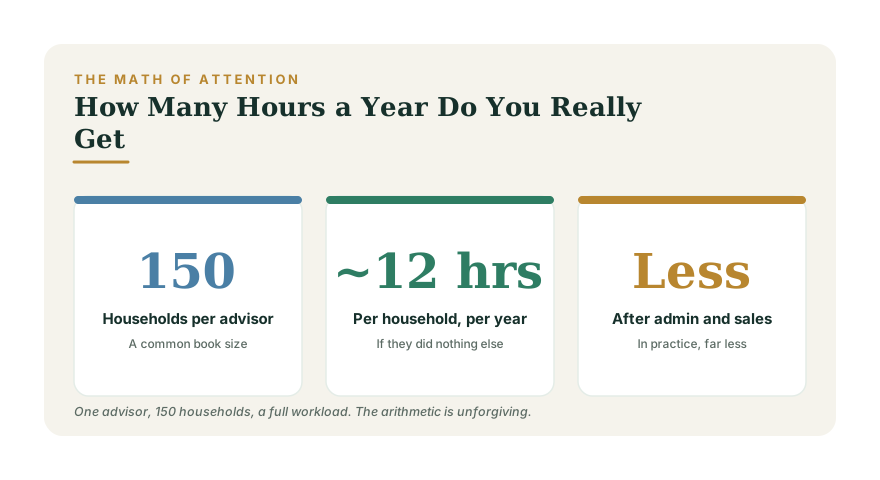
A common book of business for an advisor is 100 to 200 households, and many manage more. Take 150 as a middle case. A working year has roughly 2,000 to 2,200 hours. If an advisor spent every single working hour on clients and nothing else, that is about 13 to 14 hours per household per year.
But advisors do not spend all their time with clients. A large portion of their week goes to compliance paperwork, internal meetings, continuing education, portfolio administration, and, crucially, prospecting for new clients, because growth is how the practice grows revenue. Realistically, the direct attention any one household receives can fall to a handful of hours a year, much of it consumed by a standardized annual review.
That is the structural reality behind the relationship you are sold. There is no villain required. One person simply cannot deeply know 150 financial lives, with their tax situations, family dynamics, fears, and goals all shifting year to year.
Follow the Money
The percentage-of-assets fee model quietly rewards collecting more clients and more assets, not going deeper with the ones you have. Every new household added is more recurring revenue at little extra marginal effort, because the portfolio work is largely templated. The incentive is breadth, not depth. That is why the "relationship" is often the marketing wrapper around what is, underneath, a standardized model portfolio applied across hundreds of accounts.
It also explains the upsell. The annual review is frequently where new products surface, an annuity, a managed account, an insurance policy, because client meetings are scarce and valuable selling time. The relationship is partly a distribution channel.
Signs Your Advisor Does Not Actually Know You
- Your portfolio looks suspiciously like a one-size-fits-all model, with little connection to your specific goals, timeline, or tax situation.
- Meetings center on market performance and product recommendations rather than your life, your plans, and what is changing for you.
- You rarely hear from them between annual reviews, and when you do, it is often a sales touchpoint.
- Big life events, a new baby, a job loss, an inheritance, an aging parent, did not prompt a meaningful change in your plan.
- They cannot recall basic facts about your situation without flipping through a file or a CRM screen.
The Test
Here is a simple, fair experiment. At your next meeting, ask your advisor to tell you, from memory, your three most important financial goals and roughly when you want to reach them. Then ask them to name your single biggest financial worry.
An advisor who genuinely knows you will answer easily, because your goals drive every recommendation they make. An advisor who is managing you as one of 150 accounts will hesitate, reach for notes, or describe generic objectives that could apply to anyone. The answer tells you what you are really paying for.
This is not about catching someone in a gotcha. It is about honestly measuring the gap between the service you believe you are buying and the one you are actually getting. If the answer is vague, it does not necessarily mean your advisor is dishonest. It usually means the model they work within physically cannot deliver the depth their marketing promises. Either way, you deserve to know which one you are paying 1 percent a year for.
How to Protect Yourself
- Run the recite-my-goals test above. Make it specific and watch how they respond.
- Ask directly how many households the advisor personally serves. More than 150 is a red flag for individualized attention.
- Ask who actually does your planning work. Sometimes the relationship advisor is a salesperson and the real analysis is done by junior staff or software you never see.
- Decide what you are actually buying. If you want true depth, you may need a smaller, fee-only planning practice that intentionally limits its client count, often for a flat or hourly fee.
- If you mostly want competent portfolio management and not a relationship, stop paying relationship prices for it.
An Honest Recommendation
If a relationship is genuinely what you value, seek out a fee-only fiduciary planner who deliberately keeps a small book and charges a flat or hourly fee, so attention is not stretched across hundreds of accounts. If what you really need is a sensible, low-cost, automatically managed portfolio, a robo-advisor or a simple set of index funds delivers exactly that without pretending to be your friend, and without the 1 percent price tag attached to the friendship. Pay for depth where it is real, and stop paying for the illusion of it where it is not.
The clearest way to know whether your advisor knows your goals is to first know them yourself, in writing. Define your top three goals and your biggest worry in your plan, then check your scores to see where you actually stand. Walk into your next meeting with that page open and find out, in one question, whether the relationship is real.